3geeks — intent to website
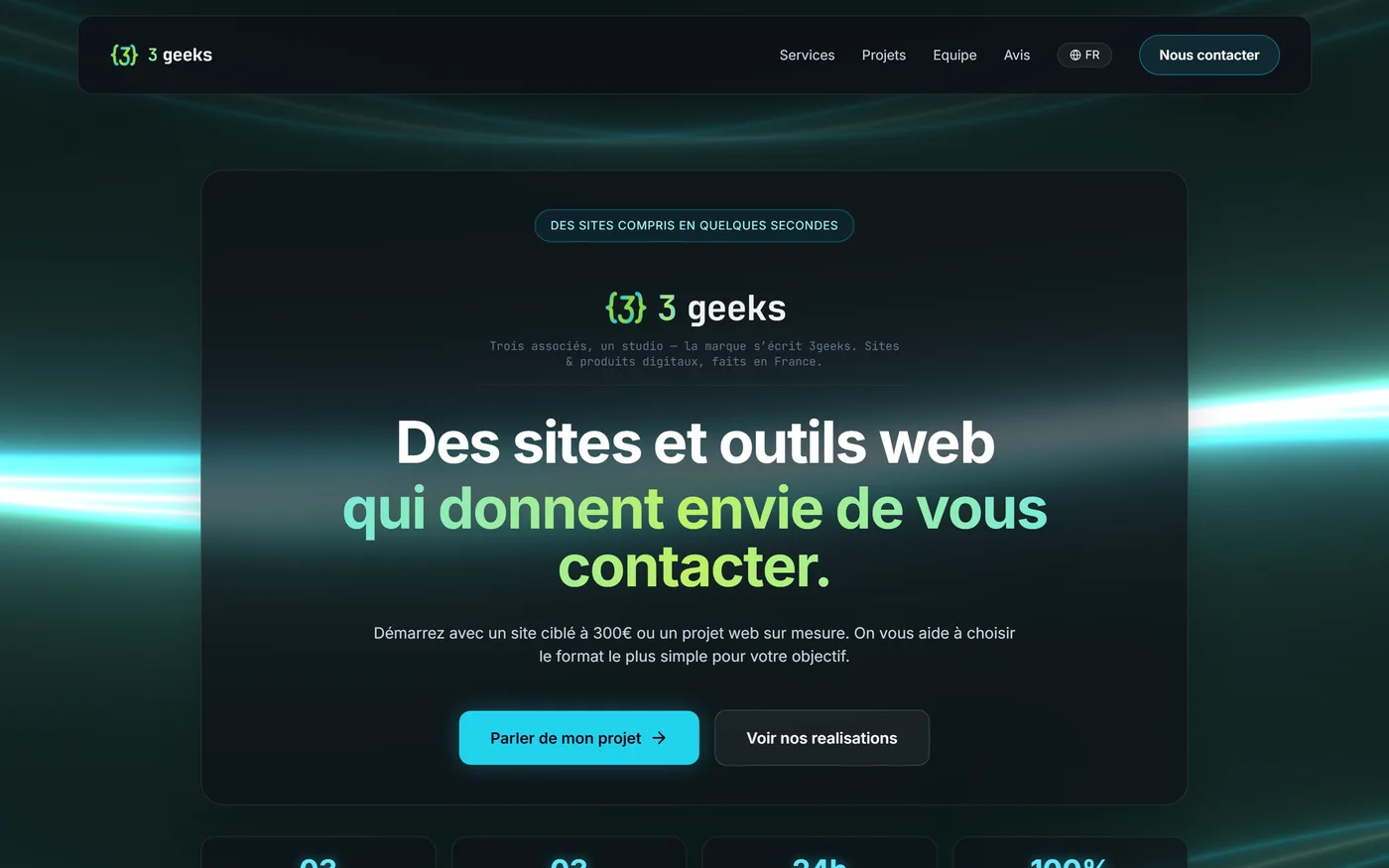
The flagship of our two-person studio: describe the site you want in plain words, and 3geeks turns that brief into a fully laid-out, ready-to-ship website — live at www.3geeks.fr.
The problem
Getting a website made is still slow and expensive for most small businesses. You either fight a generic site-builder and its templates, or you hire an agency and wait weeks for a first version. In both cases, the hardest part gets lost in translation: what you actually meant.
Large language models changed that equation. If a model can understand intent, then a plain-language brief — “a warm landing page for my bakery, with our story and opening hours” — contains everything needed to design a site. The missing piece was the machinery to go from that sentence to real, structured pages.
What we built
3geeks is an intent-to-website generator: one flow takes a text brief, extracts the intent, plans the site structure, and renders a fully laid-out website. No canvas, no drag-and-drop — the brief is the interface.
Multi-step prompting turns a brief into structure
Generated layouts rendered as real components
App Router, streaming, deployed on Coolify
Built by the 3geeks studio — Elias & Noam
My role
3geeks is two friends and partners — Noam and me — and no one gets to do just one job. Charles, a friend and former partner, now brings us projects as a business referrer. I work across the product: LLM orchestration and prompt design, the Next.js front end, and the pipeline that turns generated structure into rendered UI.
What it unlocked
3geeks became the engine of the studio. Around it, we shipped real products for real clients — each one proof that a two-person team with an AI-native workflow can deliver production software:
Want the full story?
3geeks is one chapter — the portfolio reads like a book, from a Minecraft kid to data and AI engineering.